You have a task that eats hours every week, you have decided it is worth fixing, and now you want to know what it will cost to have someone build it. You search, and you find marketplace profiles with hourly rates all over the place, agencies that only say “contact us”, and calculators in dollars that don't fit your business.
Rates differ by country, experience and type of work, so any single number would mislead you. What I can give you is what drives the price, which costs people forget, and how to check whether a quote makes sense for your business.
The three ways consultants charge
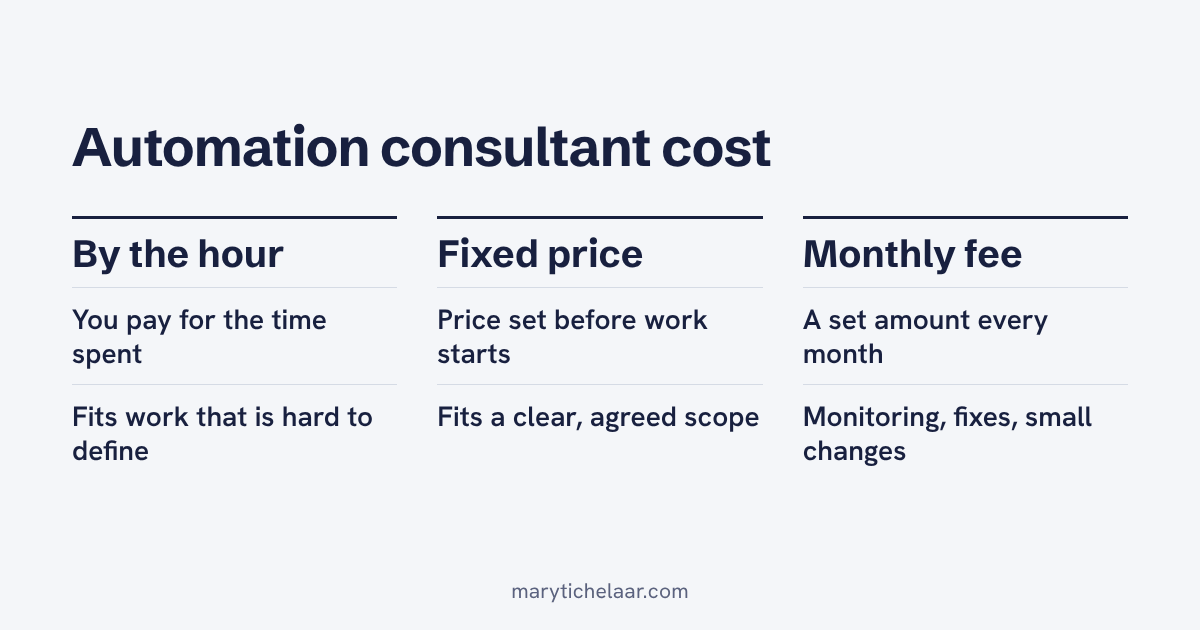
Most automation consultants and freelancers work in one of three ways, and many combine them.
By the hour. You pay for the time spent. This is fair when the work is hard to define in advance, such as fixing an existing build nobody understands. The risk sits with you: if it takes longer, you pay more.
A fixed price for a defined scope. You agree on what will be built and what you get at the end, and the price is set before work starts. The risk sits mostly with the consultant, so a good one will want to look at your process before quoting. Be wary of a fixed price given without any questions about how your work runs today.
A monthly fee for ongoing support. You pay a set amount for monitoring, fixes and small changes. This makes sense once you have several automations running and nobody in-house to look after them.
How I charge, and why
I prefer an hourly rate myself. It is easy to explain, and you pay for the work that was done. But on clear projects I see that a fixed scope with a fixed price, agreed after I have seen the process, works better for both sides. You know the cost before anything is built. I am rewarded for working efficiently, instead of earning more when something takes longer.
For open-ended or ongoing work, such as untangling an old build or looking after automations every month, I still work by the hour.
The way in is an operations scan with a fixed price: €950 for teams of up to 10 people, or €1,350 for teams of up to 25, excluding VAT. After the scan I have seen how you work, so a fixed quote for the build is based on your real process. The operations scan page says what it includes.
What makes a project cost more
Two projects that sound the same (“connect our form to our CRM”) can differ a lot in effort. These are the things that make the difference.
The number of tools involved
Every tool adds a connection to set up, test and keep working. A flow between two tools that connect out of the box is small. A flow that touches your CRM, your invoicing tool, a shared drive and a chat tool is several small projects in one.
The state of your data
If client names, project codes or email addresses are recorded differently in different places, someone has to decide which version is right and clean it up. That work is often bigger than the automation itself, and it is worth doing anyway.
How many exceptions there are
The normal case is usually quick to build. The time goes into the exceptions: the client who pays in two parts, the project that pauses for a month, the supplier who sends two invoices in one PDF. The more exceptions your process has, the more it pays to simplify before building.
Whether there is an AI step
Reading documents or sorting requests with a language model adds work: writing the instructions, testing on real examples, and building a check for when the model is unsure. It can be well worth it, but it is not a free extra.
Documentation and handover
A build without documentation is cheaper on the day and more expensive the first time something breaks. Ask whether the quote includes a written description of what was built, which accounts it uses and what to do when it stops.
Costs that are easy to forget
The consultant's fee is not the whole cost. Budget for these as well.
- Tool subscriptions. Zapier, Make, n8n, and paid tiers of HubSpot or monday.com all charge monthly, and the price often depends on how much the automation runs. These should be in your own accounts, in your company's name.
- Your team's time. Someone has to explain the process, test the first version with real cases, and tell the builder what is wrong. Plan a few hours for this.
- Upkeep. Tools change, people leave, a field gets renamed. Either someone in your team learns to look after it, or you pay someone to.
- Changes later. Your business will change. Small adjustments are part of owning an automation.
The cheap build problem
A low price is not always a saving. A build becomes expensive later when it runs on the builder's personal account, nobody knows the login, there is no description of what it does, and nobody notices when it breaks.
Those problems come from treating the build as a one-off job. Your business will depend on it, so it needs company accounts, a clear owner and a written description. Whoever you hire, ask who owns the accounts and what you get in writing at the end.
Work out whether it pays for itself
Before you compare quotes, do your own sum. A worked example, with made-up numbers:
- The monthly check takes 6 hours.
- The person doing it costs the business, for example, €40 an hour including overheads.
- That is €240 a month, or €2,880 a year.
- If the automation brings the work down to an hour a month, it saves about €2,400 a year, minus tool costs and upkeep.
Now you know roughly what the build is worth to you. If a quote would take three years to pay back, either the scope is too big or this is not the right task to start with. Also count what the sum leaves out: fewer mistakes, and the person who used to do the check getting part of their week back.
For a B2B service company I worked with, the manual invoice check now takes about 10% of the time it used to. You can see how that was set up on the invoice checks project page.
Questions to ask before you hire anyone
- Will you look at how we work now before you quote?
- What exactly is included, and what is not?
- Whose accounts will it run on?
- What do we get in writing when it is finished?
- What happens if it breaks after handover, and what does that cost?
- Have you built something similar, and can you show how it worked?
A consultant you can work with will be glad you asked.
When you don't need a consultant
If the job is a single connection between two tools that already have a ready-made template, such as a form that adds a contact to your mailing list, try it yourself first. Most tools have good guides for this. Bring someone in when the job crosses several tools, has exceptions, touches money, or when you want it to keep working without you thinking about it.
Frequently asked questions
Is it cheaper to hire a freelancer on a marketplace?
The hourly rate is often lower. Whether the total is lower depends on what you get: a build in your own accounts, documentation and someone to call when it breaks. Compare what is delivered, not only the rate.
Should I pay per hour or a fixed price?
A fixed price works well when the scope is clear and the consultant has seen your process first, so you know the total in advance. Paying by the hour fits work that is hard to define or that keeps going, such as untangling an old build or regular support. Either way, ask for a written description of what will be done.
How much do the automation tools cost each month?
It depends on the tool and how often your automations run. Zapier, Make and n8n all have free or entry plans and charge more as usage grows. Check each vendor's current pricing page, and estimate how often your flow will run before you choose a plan.
Do I need a monthly support contract?
Not for one simple automation. Once your business depends on several, it helps to have someone checking them regularly, either a person on your team with clear documentation or an outside specialist.
If you want to know what your own task would take, book a get-to-know call. I'll tell you on the call whether it is worth building. Or get one practical tip a week in The Monday note.